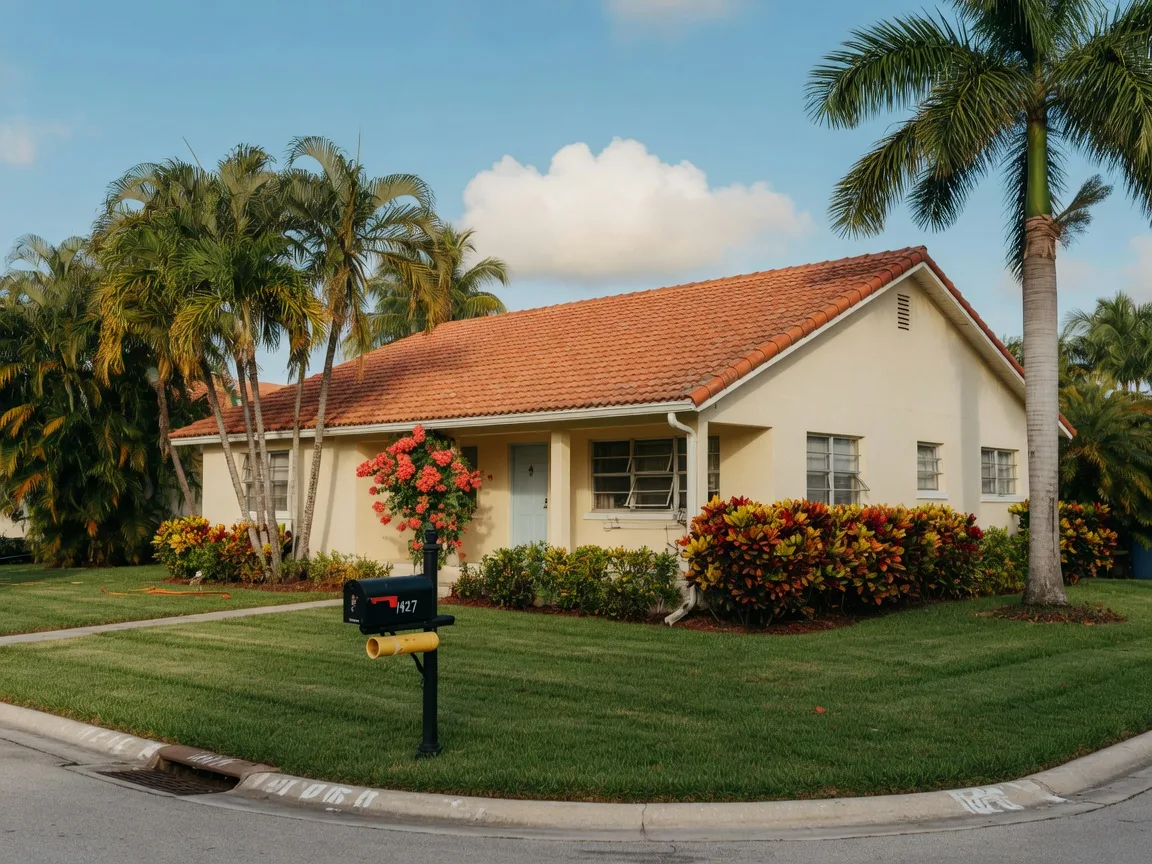
If you bought your first Florida home this year, your first property tax bill is on its way. County tax collectors mail them in late October and early November, payment is due by March 31, and paying early earns a discount: 4% off in November, then 3% in December, 2% in January, and 1% in February (Florida Department of Revenue). And the homestead exemption, if you qualify, can lower that bill from your very first year.
Why the first bill can feel confusing
Property taxes in Florida are collected in arrears, meaning you pay for the current year based on the value of your home as of January 1. If you closed mid-year, your portion is prorated at closing, so the first bill you receive may not look like the number you budgeted. Some buyers never see the bill at all, because their lender collects it monthly into an escrow account. Either way, understanding how the number is built turns a surprise into a plan.
The homestead exemption, in plain numbers
If your Florida home is your permanent residence and you owned and lived in it as of January 1, you can file for the homestead exemption with your county property appraiser by March 1. The first $25,000 of assessed value is exempt from all property taxes, including school taxes. A second $25,000 of exemption applies to assessed value between $50,000 and $75,000 and removes that slice from most non-school taxes (Florida Department of Revenue). It does not apply to school taxes, and the value between the two bands is not exempt.
Save Our Homes and portability
Two more protections keep Florida property taxes famously stable for long-time owners. The Save Our Homes amendment caps the annual increase in your assessed value at 3% or the rate of inflation, whichever is lower, so your bill cannot jump just because the market heats up. And if you later sell and buy another Florida home that becomes your homestead, you can take up to $500,000 of your accumulated Save Our Homes benefit with you, as long as you establish the new homestead within three tax years (Florida Department of Revenue).
The early-payment discount is real
Paying your bill in November, the month it arrives, takes 4% off the total. December earns 3%, January 2%, February 1%, and the full amount is due by March 31. On homes where the bill runs into the thousands, that November discount is real money you keep, and it is the easiest discount in Florida to collect.
What to do with your first bill
Check whether your lender escrows taxes, since many do and will handle payment for you. If you pay directly, set a calendar note to pay by November 30 and keep the 4%. And if you have not filed for the homestead exemption yet, the March 1 deadline is the date you do not want to miss; your county property appraiser's website has the one-page form. Property taxes belong in the same budget conversation as insurance and HOA dues, and I wrote about those recurring costs here.
The honest note: I am a Realtor, not a tax professional, so use this as a plain-language map and confirm your exact numbers with your lender or a tax professional. If you are shopping for a home and want to know what the property taxes on a place you love really run, send me the address and I will pull the current numbers for you, in English or Spanish. A bill you understand is a bill you can plan around, and that is exactly how I like to start.

Written by
Ruth Rivera
Broker Associate with Coldwell Banker Realty, in real estate since 1992, with offices across Florida. 1000+ homes sold, licensed in Florida (BK3168285). Bilingual, English and Spanish.
Have a question about your specific situation?
Ruth answers personally, in English or Spanish. She's got your back.
Ask Ruth